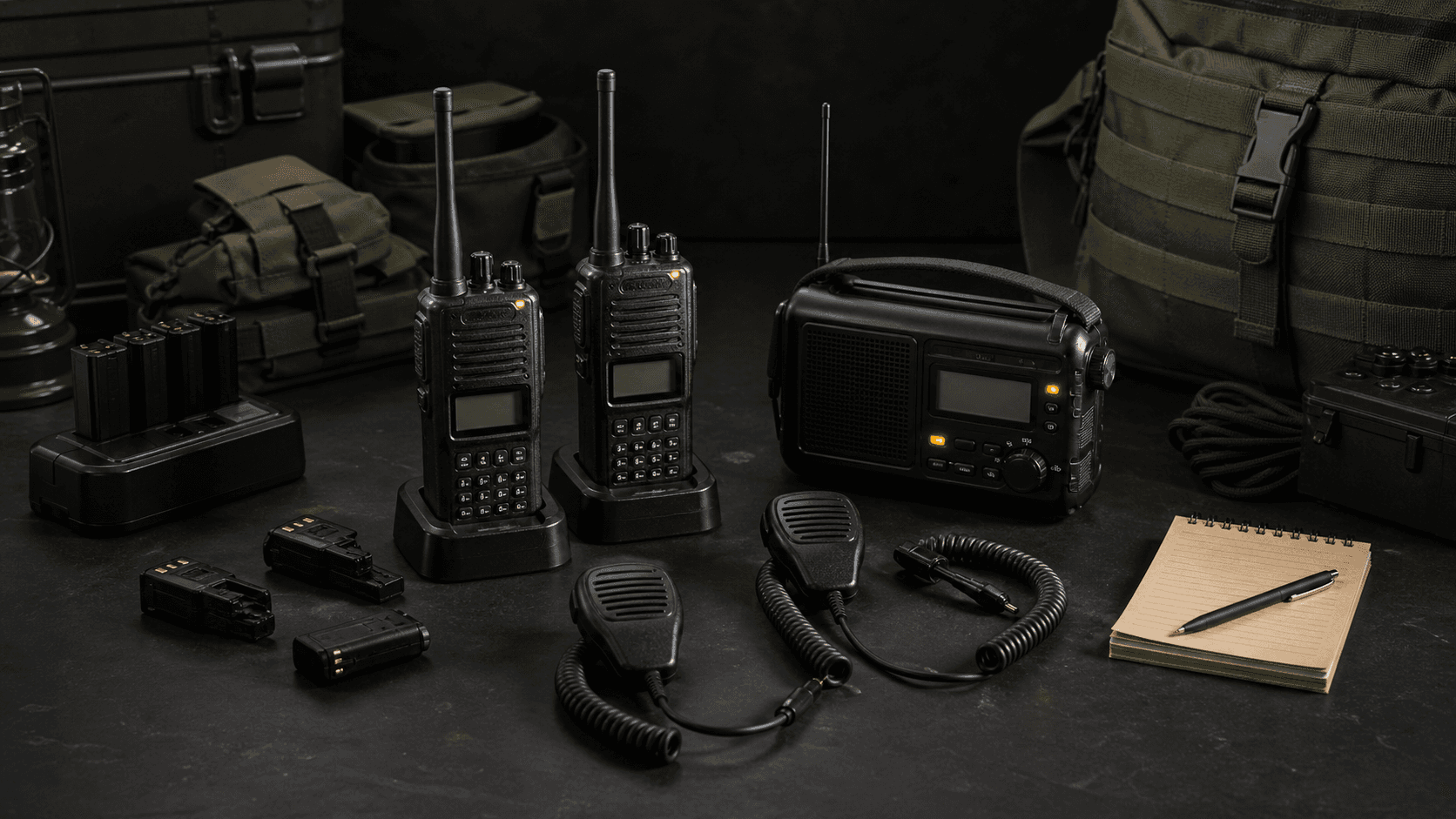
A Radio Is a Tool, Not a Talisman
Disasters — storms, floods, grid-down, or just a dead cell tower — are exactly when you'll wish you had a backup way to talk. But a radio, like a gun, doesn't protect you just by being in the bag. You need a plan: who you're talking to, on what frequency, and what you'll do when the normal infrastructure is gone. Start with the plan, then buy the gear that fits it. Adapted from T.REX ARMS — 'An Introduction to Radios and Emergency Communication' (https://www.youtube.com/watch?v=nzDj0u1HhvE).
Bands & Licenses: What You're Legally Allowed to Do
Listening is always legal — if a signal reaches your antenna, you can receive it. Broadcasting is where the rules start. FRS (the little UHF walkie-talkies) needs no license and is the easiest on-ramp for a family or small group. GMRS gives you more power and repeaters with a cheap no-test license that covers your whole household. Business/itinerant frequencies allow encryption (handy for privacy) with a license. Amateur (ham) radio unlocks the most range and repeaters and requires a test — but you may NOT encrypt on ham bands. Pick the tier that matches your group and your willingness to get licensed.
The Gear Tiers
Start simple. An entry dual-band handheld like the Baofeng UV-5R does an enormous amount for the price: analog FM, VHF/UHF ham bands, repeaters, scanning, and computer programming for about $23. The Baofeng UV-82 adds dual-PTT at about $27, and the Baofeng BF-F8HP gives you an 8W option around $56. They are learning tools and useful radios, but they are not permission slips; transmit only where your license and the radio's certification allow it.
If you want a better-built analog handheld, the Yaesu FT-60R is the classic step-up at about $156. For no-test family or group use, stay in the lane the radio is built for: Midland X-Talker T10 for FRS, Midland GXT1000VP4 for a GMRS pair, or a Midland 50W Micro-Mobile GMRS radio when your licensed GMRS plan needs more power and a vehicle or base setup. The point is not to buy the fanciest radio. The point is to buy the tier that matches your legal channel, range, and group.
HF is the long-range tier. It unlocks what the transcript is excited about: voice, Morse code, and digital modes that can reach across states or farther with the right antenna and conditions. It also costs more, takes more power, is bigger than a handheld, and demands more learning. Do not skip the cheap local plan because HF sounds powerful. Build the local net first, then add HF when you have the license, antenna discipline, and practice to use it.
Have a Group Plan
Radios get useful when your people know what to do before the emergency. Pick the primary frequency or channel for the circle you actually trust, then pick backups. Write them down. Decide when people monitor, what names or call signs they use, how long they listen before moving to backup, and where they go if radios fail. A family FRS plan, a licensed GMRS plan, a ham repeater plan, and a business-band plan are different systems; do not mix them casually just because one programmable radio can tune near them.
The transcript's model is two layers. One is the small talk-around net for your own group. For T.REX, that meant itinerant business-band frequencies with DMR digital radios and encryption, because encryption is allowed there with the right license and not allowed on ham. The other layer is wider listening: FRS, MURS, CB, ham repeaters, weather, and the EMS/fire/emergency-management channels that often sit just above the VHF/UHF FRS and MURS blocks. Some public-safety systems are trunked or encrypted; treat monitoring as awareness, not a guarantee.
Build redundancy into the plan. Have a primary and backup channel, spare batteries, a USB charging path, printed frequency cards, and at least one way to listen outside your small circle. If the plan requires reaching another county or another state, that is not a handheld wish; it is a repeater, mobile radio, HF receiver, or licensed HF station problem. Decide that now, then practice it.
Learn Before You Need It
Learn now, while the internet is up. The transcript is blunt about the bad plan: buying a cheap Chinese radio, leaving it in the box, then trying to charge it, scan, and understand the manual after the power goes out. Use the easy tools first. Online KiwiSDR receivers let you listen across big chunks of spectrum before you buy anything, so you can learn what HF, digital signals, broadcast, and local traffic actually sound like.
Practice receiving, programming, charging, and handing the radio to someone else. Learn which services you can only listen to, which ones you can legally transmit on, and which ones your group will actually use. If you are going into ham, study and test before you need repeaters or HF. If you are going into GMRS or business-band, get the license and build the channel plan before the emergency.
The most important piece is still the small community. A radio is powerful because another prepared person is listening. Build the group of family, neighbors, or trusted friends who will keep radios charged, know the plan, and answer when called. Once you know those people and what you are trying to accomplish, the equipment stops being random gear and becomes a real communication system.