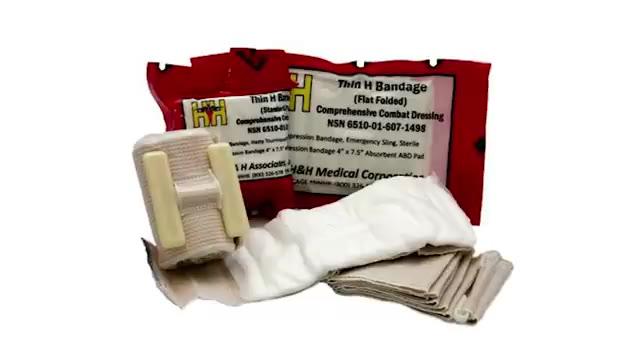
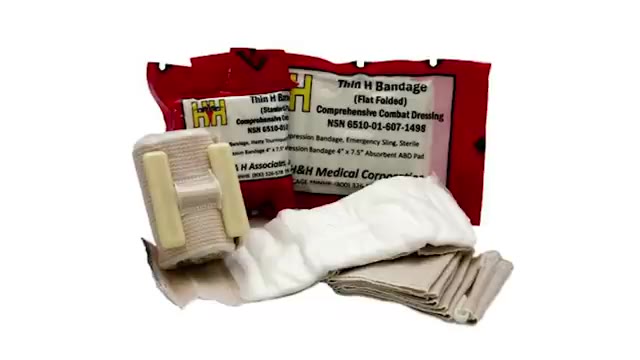
 Frame from Tactical Rifleman’s IFAK video — watch the full walkthrough.
The SF Medic Philosophy: Less Is More
This guide is based on how a Special Forces medic actually sets up his Individual First Aid Kit, as demonstrated by Tactical Rifleman. The core philosophy is counterintuitive: carry the bare minimum amount of gear. The reason is simple — if your medical kit is too large, you'll leave it in the vehicle. A kit that's always on your body saves more lives than a comprehensive kit that's 200 meters away when you need it.
The SF approach strips away the nice-to-haves and focuses on what actually stops people from dying in the field. No graphic instruction cards. No rubber gloves for the basic kit — as the medic puts it, "if it is one of my buddies bleeding out, I'm not gonna take the time to put them on." Every item earns its space by being critical to the three preventable causes of death in trauma: massive hemorrhage, tension pneumothorax, and airway obstruction.
This doesn't mean you shouldn't carry more. The medic carries additional medical gear on the back of his body armor and larger trauma bags in vehicles. But the IFAK — the kit that's always on your person — stays small, fast, and accessible. Murphy's Law is real: if your kit is on the wrong side of your body or too bulky to mount properly, it will fail you when you need it most.
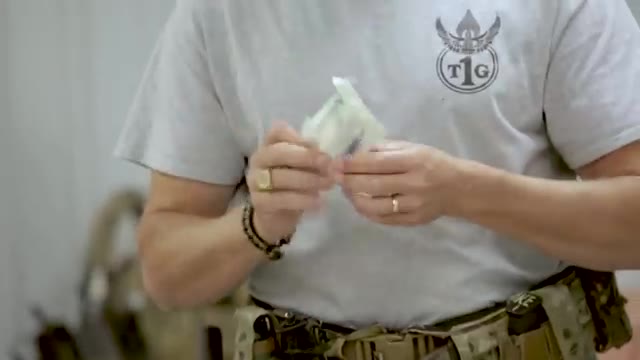 Frame from Tactical Rifleman’s IFAK video — watch the full walkthrough.
The Core Kit: What Goes In
Here's the actual loadout, in order of priority:
Tourniquet — SOF-T Wide — The SOF Tactical Tourniquet Wide is the medic's choice. Position it where you can reach it with both hands — this is critical. If your tourniquet is only accessible with your right hand and your right arm is the one hit, you're done. The SOF-T Wide and the CAT Gen 7 are both TCCC-approved. The SOF-T has a wider strap (1.5") that distributes pressure better and a metal windlass that won't snap. Cost: ~$30-32.
Chest Seal — For penetrating chest trauma. A bullet or blade that enters the chest cavity causes a pneumothorax — air enters and collapses the lung. The chest seal covers the hole. Vented seals (like the HyFin Vent) have one-way valves that let trapped air escape. Get a twin pack — one for entry, one for exit. Cost: ~$16.
Roller Gauze — Kerlix (Minimum 2 Rolls) — This is where the SF approach differs from most IFAK guides. Instead of relying solely on expensive hemostatic gauze, the medic packs Kerlix roller gauze as the primary wound packing material. Kerlix is cheap, effective, and you can carry multiple rolls. You stuff it directly into the wound cavity and apply pressure. Two rolls minimum — serious wounds eat gauze fast. Cost: ~$2-3 per roll.
Combat Gauze (Nice to Have) — QuikClot Combat Gauze is hemostatic — it has kaolin that accelerates clotting on contact. The medic calls it "nice to have" rather than essential. It's expensive ($42-46 per roll) and has a shelf life. If you can afford it, carry one. But Kerlix with direct pressure works when combat gauze isn't available. Cost: ~$42-46.
Ace Wraps (At Least 2) — After packing a wound with Kerlix or combat gauze, you need to secure it with sustained compression. Ace elastic bandages wrap over the packed wound and hold everything in place. This frees your hands to treat other injuries or move the casualty. The medic carries at least two. Cost: ~$4-5 each.
Duct Tape (3 Feet) — Roll three feet of duct tape tightly around a pen or credit card. It weighs almost nothing and takes up no space. Uses: securing bandages, improvising a chest seal, taping splints, marking casualties, sealing packaging. The most versatile item in your kit. Cost: ~$5 for a roll (enough for 10+ kits).
Nasopharyngeal Airway (NPA) — A soft rubber tube inserted through the nose to maintain an airway in an unconscious casualty. Size it individually — one size does not fit all. Comes with a lubricant packet. Requires training to use safely. Cost: ~$5-8.
14 Gauge Catheter (Advanced) — For needle decompression of a tension pneumothorax. Only carry this if you are trained in the procedure. Inserting a needle into someone's chest without training can kill them. If you're not a medic or haven't taken TCCC, skip this entirely. Cost: ~$3-5.
What He Leaves Out (And Why)
The SF medic deliberately excludes several items that appear in most IFAK checklists:
Rubber Gloves — "If it is one of my buddies bleeding out, I'm not gonna take the time to put them on." In a combat or emergency scenario, seconds matter. Gloves add fumble time. For a range IFAK or civilian kit where you might be treating strangers, gloves make sense. For a personal IFAK carried into harm's way, they're weight and bulk.
First Aid Instruction Cards — If you need to read a card to save someone's life, you haven't trained enough. The card takes up space that could hold another roll of gauze. Train until the procedures are muscle memory, then ditch the card.
Israeli Bandage — The medic uses Ace wraps instead of Israeli bandages. Both serve the same purpose (securing wound packing with compression), but Ace wraps are cheaper, more versatile, and you can carry multiples for the same weight. Israeli bandages have the built-in pressure bar which is convenient, but Ace wraps work just as well with proper technique.
Trauma Shears — Not in the minimal IFAK. The medic carries shears separately on his kit, not inside the IFAK pouch. If you're building a range bag or vehicle kit, include them. For a belt-mounted personal IFAK, they take up too much space.
The philosophy is clear: every cubic inch matters. If an item isn't directly saving a life in the first 5 minutes, it doesn't go in the personal IFAK. It goes in the extended kit on your armor or in the vehicle bag.
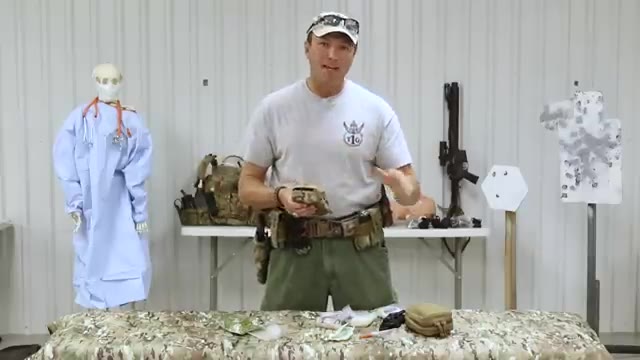 Frame from Tactical Rifleman’s IFAK video — watch the full walkthrough.
Placement and Accessibility
Where you mount your IFAK matters as much as what's inside it. The SF medic's rule: you must be able to reach your IFAK with both hands. If it's on your right hip and your right arm is injured, you need to reach it with your left hand. If it's on your back and you're on your back, you can't reach it at all.
Best positions:
- Belt, non-dominant side — Accessible with either hand whether standing, kneeling, or seated. This is the most common position for a personal IFAK.
- Plate carrier cummerbund — Works well on the non-firing side. Tear-away pouches let a buddy rip your IFAK off and treat you.
- Lower back / 6 o'clock — Accessible while seated in a vehicle. Some carriers have purpose-built rear IFAK mounts.
Avoid mounting on your back between the shoulder blades — you can't reach it yourself, and in a vehicle you're sitting on it. Avoid the front of your plate carrier — it interferes with prone shooting and going to ground.
The tourniquet should be outside the IFAK pouch in a dedicated holder, staged for one-handed application. Windlass pre-routed, time band pulled through, velcro set. Practice drawing and applying it blindfolded — you may need to do it in the dark, in pain, with one hand.
The extended kit — everything that doesn't fit in your personal IFAK — goes on the back of your body armor or in a leg panel. This is where the medic keeps additional gauze, extra tourniquets, IV supplies, and other items. It's still on your person, just not in the quick-access IFAK.
Training and Where to Buy
Gear without training is dead weight. Take a course before you buy anything:
Stop the Bleed (Free) — Nationwide 2-hour courses teaching tourniquet application, wound packing, and pressure dressings. Find a class at stopthebleed.org. This is your minimum baseline.
TCCC / TECC Courses — Tactical Combat Casualty Care (military) or Tactical Emergency Casualty Care (civilian) are comprehensive 16-hour courses. They cover everything in your IFAK plus patient assessment, casualty movement, and triage. Dark Angel Medical and North American Rescue offer these nationwide.
Practice — Buy a second tourniquet for training (mark it with tape). Practice self-application until you can do it in under 30 seconds, either hand. Pack gauze into a pool noodle with a hole cut in it — pack it tight. Time yourself monthly.
Kit Cost Breakdown:
- SOF-T Wide Tourniquet: ~$32
- HyFin Vent Chest Seal Twin Pack: ~$16
- Kerlix Roller Gauze x2: ~$6
- QuikClot Combat Gauze: ~$44
- Ace Wrap 3" x2: ~$8
- Duct Tape (3 ft): ~$1
- NPA with Lube: ~$6
- IFAK Pouch: ~$25-55
- Total: ~$138-168
Where to Buy (No Counterfeits):
- North American Rescue (narescue.com) — manufacturer of CAT, HyFin, QuikClot
- Rescue Essentials (rescue-essentials.com) — curated trauma supplies
- Dark Angel Medical (darkangelmedical.com) — kits and components
- Amazon — search for specific brands with verified seller reviews. Never buy tourniquets from unknown Amazon sellers — counterfeit CATs and SOF-Ts have failed under tension and caused deaths.
Maintenance: Inspect every 6 months. Check hemostatic gauze expiration (3-year shelf life). Replace chest seals if packaging is puffy. If your kit sat in a hot car all summer, inspect adhesives carefully. After any use — even training — replace everything you opened.
Follow Along in Our Builder
We assembled this exact kit in the LCL IFAK Builder so you can follow the guide item by item:
Every slot matches the medic's list:
- SOF-T Wide tourniquet (plus a MOLLE holder to mount it)
- HyFin Vent chest seal twin pack
- Compressed gauze ×2 — NAR stands in for the Kerlix rolls he uses
- QuikClot Combat Gauze Z-Fold
- Self-adhering elastic wrap 2-pack — covers his "at least two Ace wraps" rule
- Duct tape (small roll)
- 28Fr nasopharyngeal airway
- 14ga decompression needle — trained users only
- MOLLE medical pouch to carry it all
Where his exact pick is out of stock we substituted the closest TCCC-appropriate equivalent. Prices update daily.
The Build
Guide- $31.95
- $9.99Tourniquet HolderCondor Tourniquet Holder MOLLE
- $17.99
- $5.49
- $46.50Hemostatic GauzeQuikClot QuikClot Combat Gauze Z-Fold
- $9.49Compression WrapACE Self-Adhering Elastic Bandage 3" (2-Pack)
- $4.89Duct TapeSurvive Outdoors Longer Survive Outdoors Longer Duct Tape 2 Pack, 2x50in Rolls, Silver, 0140-1005
- $3.50
- $15.00Decompression NeedleTactical Medical Solutions TacMed ARS Decompression Needle 14ga
- $14.99